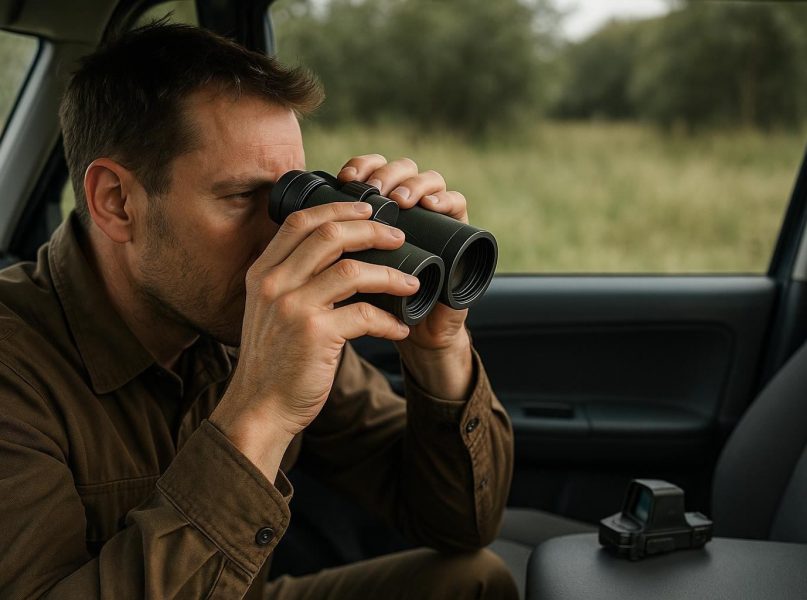
Choose your priority before choosing an optic: do you need to find a moving subject quickly, examine distant detail, or maintain a forgiving view as your position changes? A wildlife walk and a short range session make the tradeoff clear. The same instrument can feel excellent in one setting and awkward in another. Look beyond the specification sheet and consider how clarity, field of view and eye position work together when light, posture and attention are less than perfect.
Start with the task, not the feature list
Suppose you are carrying binoculars and a compact sight on a familiar property. At the edge of a field, a bird crosses from open ground into brush. You need a broad view to locate it, but once it settles, detail matters more than breadth. Later, at a safe, established range, you may value a quick sight picture and predictable alignment rather than maximum magnification.
A wide field of view helps with scanning and tracking, while higher magnification or finer resolution aids identification and precise observation. Neither replaces the other. Decide which task is most frequent, then accept the limitation that follows. Also consider how long you will hold the instrument: a view that looks impressive briefly can become tiring if it demands constant head movement or an exact cheek position.
Optical clarity is more than a bright image
Clarity is not simply brightness; the useful question is whether important detail remains distinct. Fine edges should look separated rather than smeared, and contrast should distinguish a dark subject against shaded vegetation. Glare, haze and color fringing become more distracting when the sun is low or a bright background sits just outside the viewing area.
The center may look crisp while the edges soften. That is not automatically a defect. If you use the optic mainly on a small or stationary subject, central sharpness may matter most. If you scan continuously, edge performance matters more because you use more of the image at once.
A large, bright-looking image can still lose texture in deep shadow. Test the optic against real surfaces with different tones, not only a high-contrast printed target. Let your eyes settle, and compare the same scene from the same position rather than relying on a quick glance.
Field of view changes how quickly you find things
Field of view is the amount of scene visible through the optic at a given setting. A broad view makes it easier to acquire a moving animal, follow a bird between branches or orient yourself before increasing magnification. A narrower view can make distant detail appear more prominent, but it reduces the context around the subject.
You may locate a deer quickly at low power because nearby trees and fence posts remain visible around it. Increase magnification, and the subject may fill more of the image, yet finding it again can take longer after you lower the instrument or shift your stance.
For a sight used at a controlled range, a generous viewing window can make alignment less fussy. With holographic sights, the reticle should remain usable without forcing an unnatural head position, but the surrounding view still matters for awareness and target acquisition. Exact performance depends on the design, mounting position and the user's eyes.
Eye relief is a positioning requirement
Eye relief is the distance your eye can sit from the ocular lens while still seeing the intended image. Too little usable distance can produce a black crescent, clipped edges or a view that disappears when your head moves slightly. Excessive movement can make an optic feel slow, even when its glass is clear.
During a range session, establish a repeatable position without pressing your face hard against the equipment. Move your head slightly up, down and side to side. If the image vanishes easily, note that limitation. For handheld binoculars or a monocular, check the same issue while standing and using support, since posture changes the relationship between your eyes and the eyepiece.
Eye relief is especially significant when an optic is mounted on a recoiling platform. Follow the equipment maker's safety guidance and local rules, which can change. Do not treat a comfortable static view as proof that a mounted setup is correctly positioned; safe mounting and responsible use come first.
Verify the sight picture before relying on it
Sight verification should be repeatable, not a single impression in a shop or driveway. Begin in conditions closest to your intended use. Check the image at the lowest useful setting, then at the setting you are most likely to use. Look for changes in sharpness, glare and eye-position tolerance as you adjust.
For a mounted sight, confirm that the reticle or aiming reference appears consistently from your normal, safe position. If it shifts when your head moves, determine whether the issue is eye position, mounting, adjustment or the optic itself. Do not assume a familiar-looking reticle proves that the sight is zeroed or correctly aligned. Follow the equipment instructions and verify it at a lawful, controlled range with appropriate safety procedures.
Record observations immediately:
– Can you locate the subject without repeatedly lowering and raising the optic?
– Does the image retain useful contrast in shade and against bright backgrounds?
– How much head movement can you make before the sight picture clips or disappears?
– Is the chosen magnification helping the task, or only making the image larger?
– After a break, can you reproduce the same view and alignment?
Match the compromise to the outing
If the main challenge is spotting movement across mixed terrain, field of view and forgiving eye relief may outweigh the last degree of fine detail. If the task is identifying distant markings in stable light, optical clarity and controlled magnification may deserve more weight. For a compact sight used during a supervised range session, a consistent sight picture and easy alignment may be more useful than a wide specification range you rarely use.
There is no universal best model because the variables are connected. Mounting height changes head position, eyeglasses alter eye relief, and weather and light expose weaknesses that an indoor test can hide. Make the final decision after observing these compromises, not before. A reliable optic is one whose limitations are understood, whose sight picture can be reproduced, and whose performance fits the conditions in which you will use it.